09 January 2008

24


In early December, one of the pastors at the organ church told a joke that went something like this:
A young man is sent to a maximum security prison for larceny. As in many jokes and movies about prison, the young man ends up sharing a cell with an older, veteran prisoner who takes a liking to him.

The first night in the cell block, the younger man hears something strange. Someone calls out, "Sixteen!" All the prisoners laugh, except for the new kid.

"Twenty-five!" More laughter.

After a several more numbers and much more laughter, the new guy asks the older prisoner to explain what everyone's laughing at. The older man says, "Well, at night, we've got nothing better to do than to tell jokes."

"But they're not jokes," the younger man says. "They're just numbers."

"That's all you know," the older man replies. "The thing is, we've all been here so long that we've heard all each other's jokes so often that we've memorized them. So rather than tell the whole joke again, we've numbered 'em all. Now we just remind each other of the joke by calling out the number."

"Really? Can I try it?"

"Go for it, kid."

"Eleven!"

Silence.

The young man turns to the older prisoner and says, "I don't get it. What's wrong?"

The older man shakes his head. "Some people just don't know how to tell a joke."

The only thing that made the joke funny in church is that the person telling the joke messed it up so badly that people were really confused and no one really laughed --- some people really don't know how to tell a joke.

But I had heard the joke before, a long time ago, and this time it reminded me so much of my friend Kathy that I was laughing at the joke long before Pastor Tommy started getting confused, and long before he told the punchline.

When Kathy and I were working together at Census, several years ago now, the division chief of our division back then sent an email to the entire division that said, "There are 10 kinds of people in the world - those who understand binary and those who don't." We had heard the joke before, and we thought it said 11 when we'd heard it before. My friend John said that he though it was supposed to be 11 instead of 10. So Kathy and I sent a message to everyone in our address books on our home email accounts and asked them which number they thought was funnier, 10 or 11. We also starting asking people in person or on the phone. Several of our relatives wrote back that they weren't sure which number was funnier, but that they thought the two of us were crazy and/or insane. I remember my dad thought that 10 was funnier because it was a nice, round number, and Mr. West, the guard at the front desk thought that 11 was funnier because it was closer to midnight, and he got off work at midnight.

After that, there was a SpongeBob episode were Patrick goes with SpongeBob to boating school, and the kids and I happened to see it on TV while were were shopping for batteries at a Radio Shack. Kathy happened to see the same episode. Patrick gets nervous and tells the class his name is 24, and the class laughs. SpongeBob says, "You know what's funnier than 24? . . . 25!"

And there were times when someone would say a number, and Kathy and I would just start laughing, like the time we went to Bojangles for lunch and Kathy had ticket number 24 and I had number 25, or the other way around, and we both looked at our numbers and just started laughing. The lady who took our money asked what was so funny. I told her that I was doing my SpongeBob impersonation. She said, "Yeah, I like SpongeBob, too," but she still looked at us like we were insane.

My oldest and I were at the county seat the other day and had to take tickets to talk to the ladies. We had numbers 10 and 11, and we both just started laughing.

It's not exactly like the prison joke, but there are some numbers that remind me of people or of other jokes, and they just make me laugh.

So when I saw this speed limit sign, I had to take a picture, even if it was hard to take a picture of a shining sign in the dark. Where else was I going to see a speed limit of 24?

You know what's funnier than 24?

04 January 2008

A New Year

I have had several inquiries for my consulting business --- some really interesting seasonal adjustment work and some SAS program debugging. All of the potential clients seem to be easy to work with at this point.

I'm also trying to work out a way to get some of my courses on-line for people who want to pay. I need to talk to my computer support people about this again and see if he has any suggestions. I really also need to do a mailing, but I don't know when I'm going to find the time. I have some programming projects of my own I should be working on also.

I also found out this week that I will be teaching again at Belmont for the Spring semester, which starts next week. I need to redo my syllabus and get ready to teach again. I know it will be easier this semester, but right now it seems a bit overwhelming on top of everything else.

And I have a pile of tests to grade by the middle of the month when we need to send in the next batch of work to my oldest daughter's correspondence school.

I hope everyone is having a great 2008. Go Ohio State!

ttfn

11 December 2007

Limbo

Work on the consulting side as been slow since November. That turned out to be a blessing as a fought a very bad case of poison ivy. I don't expect it to pick up until January, though I am very thankful for my few regular clients. I do have a few new prospects, so I'm not at all discouraged.

I finished all my grading for the Belmont courses. It's a relief to be finished, but I still don't know if I'm teaching next semester or not. It would be nice to teach another semester now that I have this semester under my belt, but it would also be nice to have a break. I'd really like to do a mailing, too, to drum up more business for my courses. Plus, I have some catching up to do for grading for the girls, and I would love to have more time to scrapbook (I still have a couple of pictures to paste in my Japan book).

On the other hand, I'm getting a lot of French done on the long commutes to Belmont. I feel like I'm finally getting the hang of sentence structure and basic verb forms. It's funny, though, what they've taught me and what they haven't. For example, I know the words for January, February, Monday, Tuesday, Thursday, Friday, and Saturday, but not the other months or the other days of the week. And we've learned the names for France, Belgium, Italy, England, and Canada. And I know how to ask about the time and the weather, but they keep making me practice asking about the weather in Canada or in England in January or February --- "Il faisait très froid au Canada en janvier et en février." And I can order coffee, beer, or wine, but I don't drink any of those, though I can order milk because they taught me that (I might need milk in my coffee). But, realistically, I do know that Diet Coke is "Coca-Cola Lite" in France, so I suppose I don't need to know anything else to drink. I've been renting French movies, and I'm really enjoying listening to the French. Maybe I'll learn the other months and some good things to eat that way.

I guess I'm feeling a little bit lost tonight. I should probably grade papers for the girls, but I think I'll read Dumas instead.

ttfn

12 October 2007

Saxon Math

Things are finally settling down for school this year. My high school student and I really struggled with her math course. Her high school wanted her to put in 3-4 hours a day working on math, and yet it was 95% review. She was so discouraged. She's already had Algebra I and Geometry from books by Harold Jacobs. This was an Algebra II book, and our first time with a book by John Saxon.

I thought I should look ahead in the book to see when the review would end. I discovered that there were several topics that should be covered in Algebra II that aren't in the book at all.
Algebra II should be a study of functions, and Saxon math thinks it's a study of geometric shapes and polar coordinates. It's so frustrating to me. Besides the fact that my child was hating math, I was worried that she wouldn't be ready for higher math in later years if we continued with only the Saxon book.

So I bought another Algebra II book, one by Paul Foerster. She's doing problems in both books so that she can take the tests from the first book, and we're learning all the concepts in the second (more difficult) book. Though it sounds like extra work for my daughter, she's actually doing much better in school since we started this. She's still spending 3-4 hours a day working on math problems, but she's interested in math again. She completes her assignments quickly in the Saxon book because she knows that more interesting material is coming. It's been a burden on me to figure out a schedule that will work for her school and for her, but now that we're getting it settled, I'm feeling better, too. Also, I know that she won't be getting behind in math.

Darin worries that I push my kids too much in math. I don't want to require them to be math majors, but I don't want their future career choices to be hampered by inadequate preparation, especially in math.

12 August 2007

Last Day of Summer Vacation

School starts for the girls tomorrow. And I now have two teenagers.

Maybe I'm just too tired, but I'm not so stressed over it right now. Maybe it will hit me when my oldest and I are going over her math assignment tomorrow that I have a girl in high school now. She reminded us tonight that it's less than six months before she'll get her learner's permit and be able to drive out on the roads.

The consulting business is picking up again now that summer is almost over, and I'm working on class notes for the course at Belmont for next week. When I think about what I have to do, I think that I should be really stressed about biting off too much, but right now it feels like I can handle this. We'll see how it goes. First, I still have to clean up my office and sort papers before the new school year gets too far gone.

ttfn

01 August 2007

Trip to Belmont

I took a trip up to Belmont this morning to pick up my textbook and start some paperwork. I also got to see where my office will be. (I share with the other adjuncts.) The math secretary also gave me my keys and syllabi from other professors who have taught the course in years past.

It's a nice drive, and it's a nice campus, but it's really hot today, and all the walking around campus (like walking over to Human Resources) while carrying an armload of books around really made me tired. I suppose that I should have brought along an empty book bag, but I didn't think about it until it was too late.

I need to start working on my course materials for Belmont, but what I really want to do is work on scrapbooks. I ordered more pictures over the weekend. I'm thinking that with some careful planning, I can finish up 2006 before the end of 2007. I would really like that. Then all I have to do are baby books, my trip to Japan, anything before the year 2000, the year we spent in Luxembourg . . . . . . .

New projects always seem too big at first. One step at a time, and soon I'll be able to teach Statistics 101 with one hand tied behind my back.

ttfn

11 July 2007

New school year

There have been several changes in the wind for this next school year. One change is my new teaching job at Belmont University. The other big change is that my oldest daughter is starting high school. We've been homeschooling the kids since kindergarten, but I wanted the kids to have a transcript when they finished high school. So my oldest daughter is going to be in correspondence school this year.

She and I decided on Christian Liberty Academy (CLA). I would have liked to send her to the University of Nebraska high school because of their really good reputation, but we couldn't afford it. On the bright side, we've been using some books from Christian Liberty for years, so we know what we're getting into. Also, we can take individual classes from Nebraska and still get them on her transcript from CLA. I think we might end up doing that for math. CLA only requires one year of math, so after this year, any math she takes will cost us extra, so maybe we can afford to pay a little bit more and get the course from another correspondence school.

For seventh grade for all the girls, I switched to a curriculum from Veritas Press that was more difficult than what we had been using for elementary school. This made for a big jump in time commitment and difficulty between sixth grade and seventh grade for the girls. The positive side of this is that the leap from eighth grade to ninth grade won't be so much of a leap. I'm generally pleased with the ninth-grade text books. So far my girls haven't read many short stories and poetry for the past two years, and not much American literature, and the new literature class will fill in the gaps nicely. I'm still a bit skeptical about the Algebra II book from Saxon Math, but I can supplement with my books if I need to. I think it's a bit light on the trigonometry.

We worked out a schedule for the year together, and I looked through the forms that CLA sent on a CD. Some of them I need to use for them when I send in materials for grading, but the scheduling forms were optional, and we didn't like them. I decided to program my own scheduling forms. I came up with something that the girls and I liked, and so I have the whole school year in the computer now. We can all access the calendar, and I can print out weekly schedules for all three girls. My husband thought I was completely obsessed with this project, but after years of writing out assignments by hand, I can't believe that I didn't write a computer program to do this years ago, and the programming for it took me just a few hours.

ttfn

30 June 2007

ICES III in Montreal

Every time I look at this blog I realize that it mirrors how overwhelmed I've been feeling since Daddy's death.

I had a bit of a melt-down (again (speaking of Daddy)) the day we were supposed to leave for the ICES III conference in Canada, but to make a long story short, we did finally leave that day, and we went on the trip, and the conference was good, and the girls had a good time, and we got to see lots of friends. The next step for me, professionally, is to finish up writing the papers that I presented, before the end of August.

I sent in the paperwork I needed to send to Belmont, and I'm looking forward to starting my teaching gig there in late August. I'm even looking forward to the commute --- some quality time in the car to practice with my French CD's.

The consulting business has slowed down for the summer, but it's been nice to have a break, and it was nice to have the money in the bank already to pay for the trip to Montreal.

The other big issue for us this summer was getting my oldest daughter ready for high school at her correspondence school. I'll write more about that in a bit.

ttfn

03 April 2007

About Daddy

This is the eulogy I gave tonight at Daddy's funeral:


When I was a child, I thought that everyone had the same kind of childhood that I had, and it wasn't until I was older that I learned to appreciate the uniqueness of my childhood. Let me tell you about my dad.

When I was little, before I could say the word "statistician," Daddy and I would pretend to be statisticians. We’d do little experiments in the kitchen, or we’d do a survey of words in the newspaper, and then we would graph our results. We discussed the properties of bell-shaped curves. We figured out the probability of drawing a pair of matching socks from my well-mixed sock drawer.

When I was in third grade, Mrs. Hoffman was teaching us multiplication tables, and I was bored. When I told Daddy I was bored in math, he said he would teach me a magic trick. He got out his book of logarithm tables (back in the olden days before calculators could do logarithms), and he showed me how to look up numbers in the logarithm table. Then you would take the logarithms and add them, but when you undid the logarithm they would really be multiplied. I tried it over and over for any multiplication problem I could think of, and the next day I told Mrs. Hoffman that my dad had taught me a really cool magic trick with logarithms. She called my dad later and suggested to him that he should stop teaching me at home. He ignored her suggestion.

But math to my dad was more than just the kind of math you might use as a statistician, it was the kind of math you used in sports. I learned how to compute "yards per carry" and "runs batted in." There is never a time in my life when I can remember NOT knowing the rules to football, baseball, and basketball, and I've been a Nebraska football fan my whole life. Some of you might know that my dad knew Richie Ashburn who played major-league baseball in Philadelphia and later worked for them as a broadcaster, but my dad had other connections, too. When we lived in Vermillion, South Dakota, Daddy was friends with the announcer for the town baseball team. Daddy and Don and I went to a lot of baseball games in Vermillion, and sometimes I would get to sit up in the announcer’s booth, and one time I even got to run the scoreboard, to turn on the balls, strikes, and outs. Daddy took us to high school football, basketball, and wrestling, and University of South Dakota football and basketball, too. And when we moved to Tennessee, we started going to Science Hill and ETSU games and track meets.

Time with Daddy was more than just math. Daddy read out loud to us, everything from "The House that Jack Built" and "Oh How Do We Get to the Zoo?" to Sir Arthur Conan Doyle and Edgar Rice Burrows. Daddy taught me to sing the tenor part on the hymns with him before I could read well enough to read the words of the hymns. We took family vacations out west to see the Grand Canyon and Yellowstone, and trips in the east to every major Civil War battle site, and as many of the minor ones as Daddy could find.

Daddy loved to look for patterns in every day things, from the number of petals on wildflowers to odometer readings on the car. I remember calling Daddy on his 48th birthday and asking how it feels to be 48. He said it felt a lot like 47. I called him on his 49th birthday, and he was really excited. This wasn't just any birthday. I had just turned 25, and he was 49, and that was 5 squared and 7 squared. And to make it even better, on his mom’s next birthday, she was going to turn 81, so then we'd have 5, 7, and 9 squared. I remember that he said, "We couldn't have done better if we'd planned it." And I remember thinking, but who would have thought to plan this?

No matter what happened in our lives, I always knew, without any doubt, that my dad loved me and my brothers, even when (or maybe especially when) we were being punished. I also knew, without any doubt, that he loved my mom.

It wasn't until I was much older that I realized that not every child has this kind of childhood. Not everyone grows up in such a secure and loving home with such amazing parents. I also discovered that not everyone loved math and statistics like I did.

Now I’m married with three kids of my own, and this has given me a chance to see Daddy’s teaching abilities with the next generation. I remember very clearly overhearing my dad watching a Nebraska football game on TV, and hearing him explain the kind of plays you might want to run on second and 7. I went out to see who he was talking to, and it was daughter Naomi when she was only two months old. I asked Daddy what he was doing, and he told me that it’s never too early to start training the next generation. And it works. Much to my husband’s chagrin, all three of my girls route for Nebraska. Daddy loved watching his granddaughters play soccer and going to their piano recitals. And Mom and Dad took us all on a family vacation out to Yellowstone and Custer State Park to see Daddy’s beloved buffaloes in the wild.

Besides being a mother, you might have guessed that I’m a statistician by profession. Every day I use the lessons he taught me. I teach classes on time series, and I explain to people how magical logarithm can be. I teach my girls math and music and history, and we visit as many battlefields from the War Between the States as we can manage. I still sing tenor on the hymns in church. I still have a very well-mixed sock drawer.

I could never live up to everything Daddy did. I mean, we are talking about the man who had to walk through the snow barefoot to school every day, and uphill both ways. OK, so he liked to tell stories, and I was fairly gullible, but I did always work hard at what I set my mind to do. I always wanted to do my very best, not so that my dad would love me, but because I loved him, and I wanted to be just like him.

The most important thing that Daddy taught me was to be passionate about God. Finding patterns in nature wasn't some kind of hobby with Dad, or something to pass the time. It was just one way to marvel at all the amazing gifts that God has given us, to appreciate the world around us, to see God’s handiwork in even the little things. Daddy taught me that there is beauty in everything around us. There is beauty in every situation, even the bad ones, when we can see that God is in control. When something miraculous happens and other people chalk it up to coincidence or chance, as statisticians, we can figure out the probabilities and see very clearly the hand of God. Daddy taught me how to see the Power behind the chance.

The older I get, the more I'm convinced that if someone doesn't love math, it's only because they didn't have a good teacher. So every day, I can thank God that I had the very best math teacher, right from the start.

30 March 2007

Daddy

Tonight I lost my dad to cancer. He was the greatest dad in the world, and my first and greatest math and statistics teacher. I'm so sad to lose him, but I feel so blessed to have had such a wonderful man for my dad and my mentor.

Today was the one-year anniversary of us moving back to the States. I'm so glad that we moved back to the States, and I'm so glad that we live so close to my parents' house.

23 March 2007

Graphs

If there is anything I like better than time series, it's statistical graphs.

I had a client who asked me to make some graphs for his research report. It was the most fun I've had doing statistics in a very long time.

His supervisor suggested scatter plots. They turned out to be quite helpful.


He also needed a way to compare results over many questions. So I made graphs of the confidence intervals, taking into account that he was doing multiple comparisons. Though they are a little bit crowded, it was still a great way to look at the questions and see where the statistical differences were.


I could be really happy if I could get paid all the time to make graphs for people's research.

ttfn

26 February 2007

Two-year Anniversary

Yesterday was the two-year anniversary of my leaving the Census Bureau. I'm still in touch with many of my former co-workers, and the more I hear about what is going on there, the more I'm glad I decided to leave.

I was having health problems that the doctors thought were caused by stress. I have had a very stressful past two years with moving to Europe, and moving within Luxembourg, and coming back to the States without jobs or a place to live, with a broken leg that included a hospital stay and surgery. And through it all, I haven't been sick at all (except for that broken leg). I just keep wondering if it wasn't the stress that was getting to me but something in that old building.

So now Census is getting a new building, and I suppose it beats having a lot of health problems, but anyone I know who is already in the new building isn't happy.


If I had moved into the new building, I'd have to spend my life in a sunless, noisy cubicle. Not to mention the daily commute. And there are all the meetings and all the red tape and all the reports to write for management that keep a person from doing fun work like programming and research. If I was at Census, I would be making 8-10 times more than I will make this year (just a forecast of my earnings this year), but it's not worth it to me.

Here I am in my 200-square-foot corner office, with a fireplace, easy chair, CD collection, big wooden desk, and awesome views of pasture land and wooded hills, and a commute that consists of 8 steps from my bedroom door. I like the work I'm doing because I only accept work that I will like. I have time for research and programming. I'm working part-time so I can spend more time with my kids.

So much has happened to us in the past two years that it seems like so much longer since I was at the Census Bureau. Though I seriously doubted my decisions along the way, and I doubted my ability to see God's direction for my life, it's much easier now to have some peace about my current life. I really do feel like I'm where I'm supposed to be.

I celebrated my anniversary by installing SAS software on my computer. It will take me some time to get up and running with it again, but I'm looking forward to having SAS again. I feel very hopeful about my future.

ttfn

09 February 2007

Health Insurance

The worst part of starting my own business was not knowing what to do about health insurance. I'm happy to say that the debate is over.

My husband received a notice that he would be hired on permanently and was invited to an orientation meeting yesterday morning. We were hoping that meant that he would be hired on permanently starting next week. It turns out that he was already considered permanent beginning this past Monday. That means, as of Monday, we have health insurance! With this permanent job, my husband also gets a raise, and he will qualify to transfer to other jobs in the company that he would like better.

I try not to worry, and I haven't lost any sleep over it, but a lack of health insurance was a concern for me. We are making it financially, and we have some in savings, but we don't have a lot in savings, and one really big bill would have put us in a tailspin. Now I know we're going to be OK. The coverage is really good, and we're going to get the dental also because it will give us a discount for the orthodontist. It's just really such a relief.

I just feel that a huge weight has been lifted off this family. I know we can make now.

03 February 2007

Business is good

Business is really picking up. After no paying clients in 2006, I've had a lot of work in 2007. I've even been a little bit busier than I would like because I don't want to neglect the children. They are being good sports about my working, though. I told them if I make a million dollars this year then I will buy them an in-ground swimming pool. They figured out that I should be making about $4,000 a day, so if they see me away from the computer, they ask me why I'm not working. They can be harder task-masters than any boss I've ever had. On a more realistic note, I'm hoping to pay for orthodontia for the girls, and I'm feeling very hopeful.

23 January 2007

Personal Provenance

My younger brother is two years younger than me and, as long as I can remember, he's been smarter than me. Which, now, is really cool. But when you're little, it's kind of embarrassing.

One of our favorite Catherine-was-so-stupid-and-pig-headed moments to laugh about now happened when we were probably about 6 and 8, or maybe 8 and 10. My brother and I are in the car with my parents, and my brother says something, and I'm not really paying attention because I don't understand what he said. A little bit later, I happen to notice that one of the businesses in town has a balloon hanging on its sign, and it's shaped like a little blimp. So I say, "Look, there's a little blimp!"

My brother says, "That's what I said."

My response was something to the effect: "I know you said something, but that's not what you said."

His response was something to the effect: "What I said was 'Look. there's a miniature dirigible.'"

I proceeded to have a huge argument with him about whether or not what he said was the same thing as what I said. Sometimes my parents would be upset with us for arguing all the time in the car, but this time, I think they were too busy laughing.

So about a month ago, my brother uses the word "provenance" in reference to my grandfather's organ that he was helping me move to my house. I have no idea what he's talking about. "Don't you watch the 'Antiques Roadshow'?" he asks. Well, I do sometimes, but I somehow tend to tune out words that I don't know the meaning of. Words like dirigible. You would think that my brother would know this about me already. So then my brother decides to help me improve my vocabulary and encourages me to use the word in conversation so that I will remember the word. Seein's how it sounds so French, and I'm all about learning French, you would think that I could remember this word. But I don't. I have a really hard time remembering the word whenever I find some opportunity to use it in a sentence. And I see the word all the time now, so I don't know how I missed it before. As an example, here is an article on Wikipedia about a really interesting painting by Jan van Eyck, and the article has a section on Provenance.

So I got out my very first stat book from Iowa the other day, and I find an index card with my dad's writing on it. I have a very clear memory of my dad and I sitting at the dining room table at the house we lived in when I was a kid. I really don't know how old I was, but definitely older than 4 and younger than 12, and probably about 10. I had asked my dad some questions about normal distributions, so he took out an index card from his pocket (my dad loves to carry index cards and pens with him everywhere), and his black felt-tip pen, and he drew some pictures on that card. And I remember afterwards thinking that the card was really important, because when I grew up, I was going to need to know the normal distribution. So I kept it in a safe place in my room, and the card surfaced when I was in grad school, and I was using it for a bookmark, mostly to help me not be so homesick.


I hadn't seen that card in years, and I found it today. And I realized that this is a very important part of my provenance---the documentation regarding my origins.

So I called my dad, and I tried to use the word "provenance" in a sentence, and I couldn't remember the word.

Sorry about that, brother dear.

ttfn

08 December 2006

Wishing you a Seasonally Adjusted Holiday Season!

My friend Erica used to have (and maybe still has) a cartoon on the wall of her office, and I wished I had asked her for a copy. But today I found a copy on the site cartoonbank.com.

One man to another as they walk down the street at Christmas time:
“Yes, I’m somewhat depressed, but seasonally adjusted I’m probably happy enough.”

Click here to see the cartoon at cartoonbank.com.

Cheers!

21 November 2006

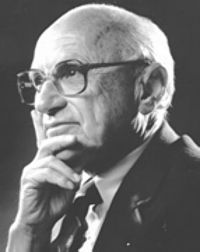
Milton Friedman, 1912 - 2006

I was sorry to hear of Milton Friedman's passing last week. I hear all this talk of Bo Schembechler and Robert Altman, but I didn't hear anything on the regular news about Dr. Friedman, and it's really too bad. Not to minimize the contributions that Mr. Schembechler and Mr. Altman have made in other people's lives, or to speak ill of the dead, but it seems that Dr. Friedman's impact can be felt around the world and will still be felt decades from now.


Milton Friedman wrote a lot of books, some of them I own and have read. He was an incredibly brilliant man, and he was really good at explaining things. He won the Nobel Prize for Economics back in 1976. According to Wikipedia, he made "major contributions to the fields of macroexonomics, microeconomics, economic history, and statistics", and his Nobel Prize was awarded for "his achievements in the fields of consumption analysis, monetary history and theory and for his demonstration of the complexity of stabilization policy."

Friedman advocated laissez-faire capitalism, and is considered to have been one of the most influential economists of the 20th century. Wikipedia says that his ideas "had a major impact on the economic policy of both the Nixon and Reagan administrations" and in other governments in other countries. Some people say that his book Capitalism and Freedom, published in 1962, was part of the reason behind the fall of communism in parts of Eastern Europe.

He explained free-market economics in a series of specials aired on PBS back in the 1980's. Some of them are on You Tube. Check out his talk about pencils. Very cool.

He was 94 years old, and he lived a really incredible life. It's too bad that more people don't know who he is.

His obituary in the Financial Times.

26 October 2006

Seasonally Adjusted Oil Prices to win an Election

I found this story on a blog (a blog with pictures that I wouldn't recommend anyone looking at because I'm not a fan of porn), with links back to www.usatoday.com that didn't work, and I can't find the original on the USA Today site either. But I love this story.

The emphasis in the article below is mine.

Many Americans look for political manipulation as gasoline prices plunge
By Brad Foss, Associated Press

WASHINGTON --— There is no mystery or manipulation behind the recent fall in gasoline prices, analysts say. Try telling that to motorists. Almost half of Americans believe the plunge at the pump has more to do with politics and the November elections, than economics.

According to a new Gallup poll, 42% of respondents agreed with the statement that the Bush administration "deliberately manipulated the price of gasoline so that it would decrease before this fall's elections." Fifty-three percent of those surveyed did not believe the conspiracy theory; 5% said they had no opinion. Not surprising, almost two-thirds of those who suspect President Bush intervened to bring down energy prices before Election Day are registered Democrats, according to Gallup.

White House spokesman Tony Snow addressed the issue Monday, telling reporters that "the one thing I have been amused by is the attempt by some people to say that the president has been rigging gas prices, which would give him the kind of magisterial clout unknown to any other human being."

Fimat USA oil analyst Antoine Halff says there is no doubt "the downturn in prices is welcome news from an electoral standpoint for the ruling party." But he scoffed at the notion that the president has the power to muscle a global market.

At a suburban Miami Mobil station, where regular was selling for $2.66 a gallon, no one was buying the conspiracy theory. "The decrease of gas prices is simply due to a seasonal adjustment of price," said Javier Gudayal, a 48-year-old attorney. "And that the Bush administration does not have the power to manipulate."

But in Los Angeles, which has some of the highest gasoline prices in the country, motorists wouldn't rule out the possibility of politicians eager to sway the electorate. Twenty-eight-year-old attorney Amnon Siegel sensed more than market forces at work. "I'm sure there's some sort of string-pulling going on," Siegel said.


I'm intrigued by the idea of seasonally adjusting gasoline prices.

I'm really good at seasonally adjusting things. If you want New Home Sales at 900 million, I could get you that answer. That's why at the Census Bureau and other government agencies, once you've set the seasonal adjustment options, you aren't allowed to change them month by month. I remember a time back in late 1992 when we knew that the estimates for New Home Sales were off, but we didn't want to change it before the election for fear that someone would think that we were trying to influence an election. As I pointed out back then, not changing bad numbers also effects the election, but no one was listening, and I was new in DC back then.

So even if someone could fix a bunch of number in a bunch of different time series, what would you have to be able to change so that you could actually influence the price of gasoline? If you seasonally adjust a time series of gasoline prices, and make the current price $2 a gallon, that doesn't mean that it will really be $2 a gallon at the pump. You'd have to be able to sway a lot of different factors to really get the prices to change.

Of course, what the 48-year-old lawyer from Miami really means is that oil prices usually come down after summer vacations are over, and with a mild hurricane season, they fell again. There are seasonal fluctuations in oil and gasoline prices. If we seasonally adjusted the prices, we'd really be paying more for gasoline now, and less for heating oil. Think about that.

ttfn

17 October 2006

Cardinals/Mets baseball

I'm a bit of a Cardinals fan, growing up in a town with a Cardinals farm league team. I admit that I like watching small town baseball better than the big boys. Maybe because I can see the game better. But I do follow baseball some, and especially the Cardinals, I suppose.

I found an article about post-season pitching titled "Seasonal Adjustment". I wonder if my seasonal adjustment software could help them with their pitching line-ups. Just kidding.

From www.courant.com

Seasonal Adjustment
Glavine, Weaver On Three Days' Rest
October 16, 2006

ST. LOUIS -- Last week's rainout of Game 1 has forced both managers to use their Game 1 starter on three days' rest for Game 5 tonight. That's postseason baseball, where nothing is routine about changing your routine. "This time of year, I think the physical side of it is taken care of by the adrenaline," said Tom Glavine, who will start for the Mets against the Cardinals' Jeff Weaver.

ttfn

02 October 2006

Paper accepted

My paper was accepted at the ICES III conference in Montreal in June. I was already going as an invited speaker, so sometimes I wonder why I wanted the extra hassle of presenting a paper, but I'm sure that it will motivate me to keep working on my research.

After some time off in September to get the kids off to a good start in school, and a trip up to the DC area, October is proving to be quite productive, and I hope to have some new papers on the web site soon.